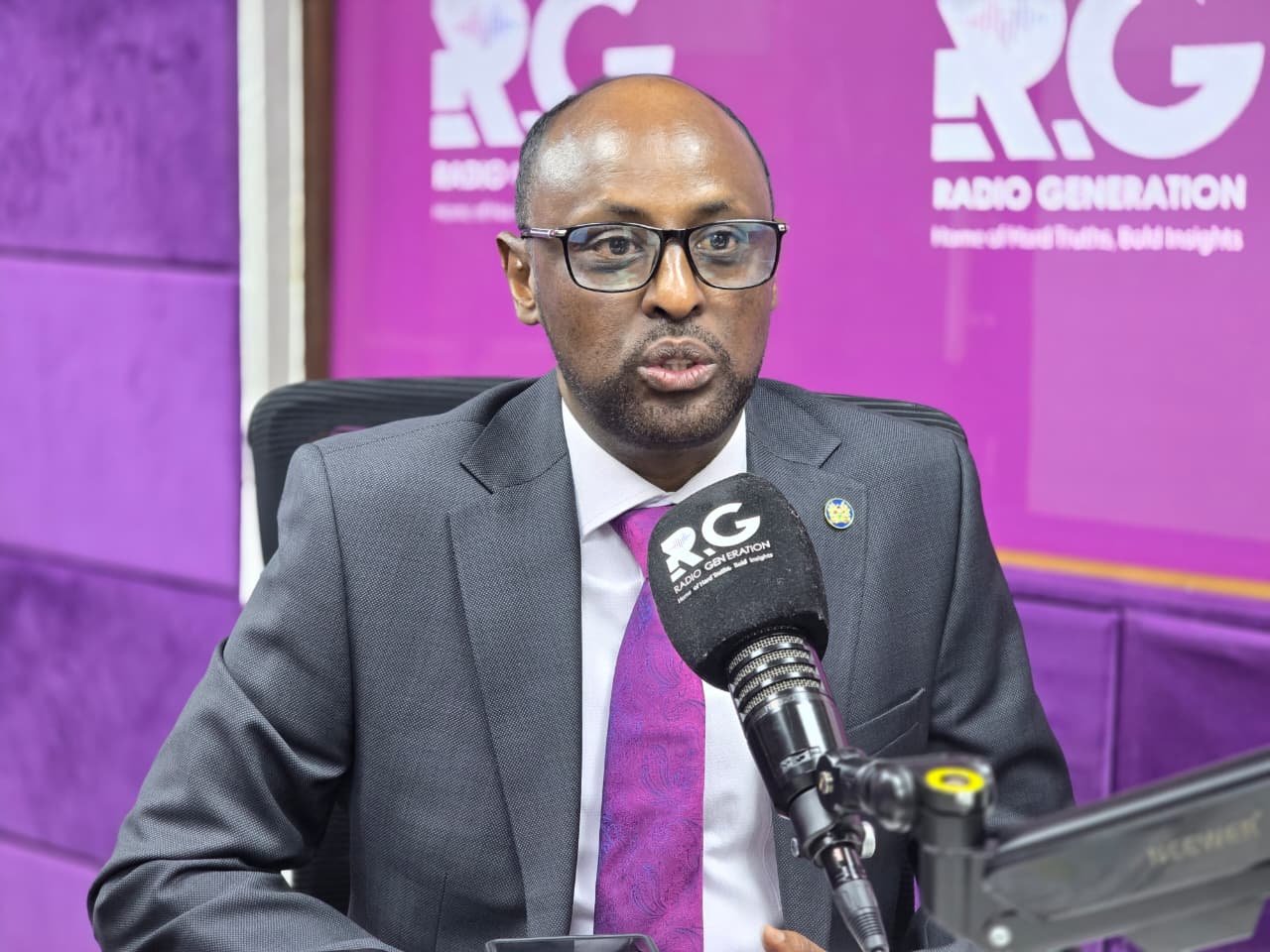
Mandera Deputy Governor Ali Maalim Mohamud has pushed back against claims that corruption is more severe in Northern Kenya, saying the problem cuts across the whole country and should not be used to single out one region or community.
Speaking during a Radio Generation interview on Wednesday, Mohamud said the growing public debate around corruption, especially when linked to Northern Kenya and the Somali community, has revealed deep-rooted misunderstandings that have existed for years. He welcomed the discussion, noting that it had created space for the region to explain its challenges openly.
“I like that this debate of corruption is ongoing, especially in light of northern Kenya, yes, and generally the Somali community, because we have never had this opportunity to actually bring out some of the challenges that we have as a community, as a region,” he said.
While admitting that corruption remains a major issue in Kenya, the Deputy Governor rejected claims that it is more common in the north than elsewhere. He said corruption affects every part of the country and should be addressed as a national problem.
“One of the biggest problems in Kenya and parts of Africa, I believe, is because of corruption,” he said, adding, “that’s not northern Kenya, it’s because the whole country is corrupt from end to end.”
Mohamud questioned why leaders from Northern Kenya often face heavier public judgment compared to others. He pointed to past cases involving leaders from other regions that did not attract the same level of attention.
“We have a former governor from Central (Waititu) in jail for corruption. He’s not from northern Kenya, right?” he said. “Nobody talks about that.”
According to him, accusations against leaders from the north are often based on perception rather than facts.
“Because this guy, or whoever, is from northern Kenya, it’s an easy option to jump to conclusion that, look, this is corruption,” he said. “And so you don’t have real evidence.”
The comments come months after former Deputy President and current Democracy for Citizens Party leader Rigathi Gachagua sparked debate by blaming leadership failures, corruption and weak accountability for continued underdevelopment in Northern Kenya.
Gachagua described the region as the ailing silent patient of the Kenyas Republic, arguing that years of government and donor funding had failed to improve living conditions in counties such as Mandera, Garissa, Wajir, Marsabit and Isiolo.
He said the region had received more than one trillion shillings since devolution began in 2013 through national transfers, the Equalisation Fund, NG-CDF and other funding channels, yet poverty, drought and poor infrastructure remained widespread.
His remarks drew sharp reactions from leaders in the north, who said the region was being unfairly blamed. The debate later drew the attention of the Ethics and Anti-Corruption Commission, which stated that claims portraying Northern Kenya as uniquely corrupt were not backed by evidence and that corruption affects the entire country.
Tensions around the issue also reached the media, with a planned interview between Gachagua and journalists from Northern Kenya cancelled following public outrage, showing how sensitive the subject had become.
Mohamud said leaders from the north were not defending wrongdoing and would support action where proof exists.
“We are not protecting anybody. We are not scapegoating,” he said. “If these claims are true and people can really give us good evidence, then I will be one of the first people to really shout out.”
He also challenged Kenyans to reflect on everyday actions that fuel corruption, saying public conversations often ignore personal responsibility.
“We talk about corruption, and yet, if you were to get down to the nitty-gritties of corruption, we are a really corrupt lot of people,” he said.
Using interactions with police as an example, he said many citizens choose shortcuts instead of following the law.
“What is our first option as Kenyans? Look for a way of going around this problem,” he said, adding, “finding the way around it is corruption.”
Mohamud described the national conversation on corruption as unfair and selective.
“We look at corruption as an othering process,” he said. “It’s always others who are corrupt.”
He said official audit reports clearly show where problems exist, but the public often ignores these records in favour of stereotypes.
“It tells you with great clarity which counties have problems,” he said, adding that public debate often goes against documented facts.
The Deputy Governor warned that constant focus on corruption in Northern Kenya risks hiding the region’s long history of neglect.
“A lot of our problems in northern Kenya, is just because a region that has never been resourced is somehow now being resourced,” he said.
He added that resentment driven by political entitlement continues to shape the debate.
“Some people are so entitled that they believe actually the resources going there should not go there,” he said.
Mohamud said the country’s progress depends on fairness and unity, warning that division would only slow development.
“For as long as we are pulling each other down, this country is not going anywhere,” he said.































Comments
Sign in with Google to comment, reply, and like comments.
Continue with Google